Blog
AI in PR: What stays, what changes – and what really matters
AI isn’t replacing PR. But it is reshaping it.
In this blog, Florian Schafroth, Managing Director of Berkeley Kommunikation, (the German branch of the Berkeley Communications Group for the DACH region), unpacks what the shift really means for comms leaders. He answers the questions clients keep asking, from the impact of GAIO and GEO to whether classic PR, content marketing and storytelling still have a future. Florian explains why comms teams need more than great stories. They need agency partners who can fuse tech and strategy without losing sight of the human voice.
When AI decides who is visible
In the past, editorial teams determined who was seen. Then SEO came along. Today, ChatGPT, Perplexity & Co. help decide whether a company appears in search queries, according to the motto: ‘If machines don’t understand you, people won’t find you’. Is that true?
This is now reality. Visibility no longer comes solely from traditional communication channels or a top Google ranking. AI systems have become new gatekeepers: they summarise knowledge, evaluate sources and provide answers. Users ask ChatGPT, not just Google. Added to this are AI-generated summaries within search engines. Search results no longer consist of ten blue links, but of condensed text built from numerous sources. If you don’t appear in these systems, you may not be found at all. That’s why companies need to see themselves not only as transmitters, but also as sources of information.
Do we now need to optimise our PR content for chatbots? And what does that mean for traditional media relations?
Nowadays, we need to formulate the content we create for both humans and machines. However, this does not mean that traditional press relations are becoming redundant. On the contrary, good media coverage directly contributes to visibility in AI systems. Bots such as ChatGPT and Perplexity prioritise independent, verified, authoritative sources and favour trustworthy specialist media and industry portals. Those who are visible there have a good chance of being mentioned by AI. Studies such as the Stanford HAI AI Index Report [https://arxiv.org/pdf/2504.07139] reinforce the same point: trust is not created through self-promotion but through neutral validation – for both humans and machines.
At the same time, traditional media relations must be accompanied by structured, semantically clear content that runs consistently through corporate communications and appears across channels such as websites and social media. Many tech companies have exciting content, but it is not ‘AI-fit.’ It often lacks structure, consistent messaging and language that AI can interpret. And it is important to stress: this is not about writing for algorithms; it is about making content comprehensible and contextual. At Berkeley, we work precisely at this interface: editing, reputation and relevance. The key is consistent storytelling across all channels. Those who communicate inconsistently risk confusing AI systems – and disappearing from search results.
How exactly does AI change communication for companies?
Most companies actually have a strong starting point: they have substance, expertise and compelling solutions. AI doesn’t change the content itself – it changes how it must be communicated.
Content must be structured, named and embedded in such a way that AI models recognise it, classify it and rate it as trustworthy. This means that expertise remains central – but it must be presented in a way that is tailored to the target group, machine-readable and contextually strong. Those who succeed in doing so have the opportunity not only to be mentioned in AI-generated responses, but to dominate as a source.
We are also seeing a broader shift in content marketing: from generalized content to specific, detailed content. This is positive, because AI tools love editorial and well-researched content that also goes into technical detail – much like journalists do.
And how do you get inside the ‘heads’ of machines?
The first requirement is to communicate in a way that machines can understand. This is where GAIO – Generative AI Optimisation – or GEO – Generative Engine Optimisation – comes into play. GAIO is essentially the new SEO: an approach in which content is structured in such a way that it is logical, trustworthy and quotable not only for humans but also for AI models. Content therefore needs a clear structure, unambiguous messages, a logical outline and – very importantly – consistent terminology (as mentioned above). If I refer to ‘cloud security’ in one place and ‘secure data platform’ in another, the AI will not recognise the connection. That is why we work with fixed storylines, clear source references – ideally including third-party references – and content elements that are both human-readable and machine-evaluable. After all, even the best stories are useless if they are not classified as relevant or trustworthy by AI.
Our Chief Storytellers – Chris Hewitt (London) Isabella Fröhlich (Munich, Germany) and Povel Torudd (Sydney) – work with clients to create these narratives. This content is the kind that can be logged by AI systems and reach the hearts and minds of real people.
So does GAIO solve the visibility problem many companies face in AI responses?
We can say that generative AI is establishing itself as the primary source of information for many users. A study by Arlington Research shows that half of decision-makers in the B2B sector incorporate AI tools into the purchasing process.
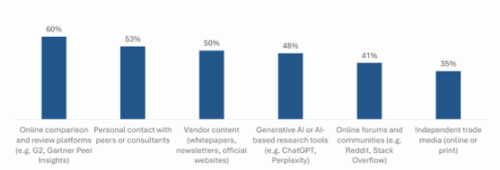
As a result, AI is increasingly deciding which brands, sources and statements are considered relevant in a given subject area. Only those who ensure technical optimisation and AI-friendly content on their websites and appear ‘off-page’ in trustworthy third-party sources such as press articles, tests, awards, studies or independent analyses (earned media!) have a chance in the competition for attention.
So PR + GAIO = the future?
Absolutely. We need both: stories that work – and structures that AI models recognise. It’s like a good conversation: you must speak and understand the language of the other party. In the past, that was editors and our clients’ target groups. Today, it is also machines such as ChatGPT. Our job is to connect the two.
And what advice would you give to companies that are currently working on their PR strategy?
Don’t start with what you want to say – start with what your target audience wants to know. Ask yourself: ‘What questions do our potential customers ask ChatGPT, Perplexity or Google? About which topics?’
Then analyse: ‘Who is mentioned in the answers – us or someone else?’
If you don’t appear, the issue is rarely the product. It is usually the communication – the sources that ChatGPT and others trust, inconsistent messages, missing structure or a story that does not convinces both humans and machines.
Our practical tip: once a quarter, gather the most frequently asked questions from sales, service or online searches – and use them to create targeted content and campaigns that answer these questions. This will make you visible, not because you are loud, but because you are relevant.
In addition, GAIO measures should be genuinely anchored in the PR and communication strategy – there are no generic tips for this. We are happy to advise companies on the basis of a GAIO audit.